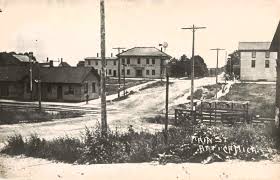
A documentary investigation of a St. Clair River family
Introduction
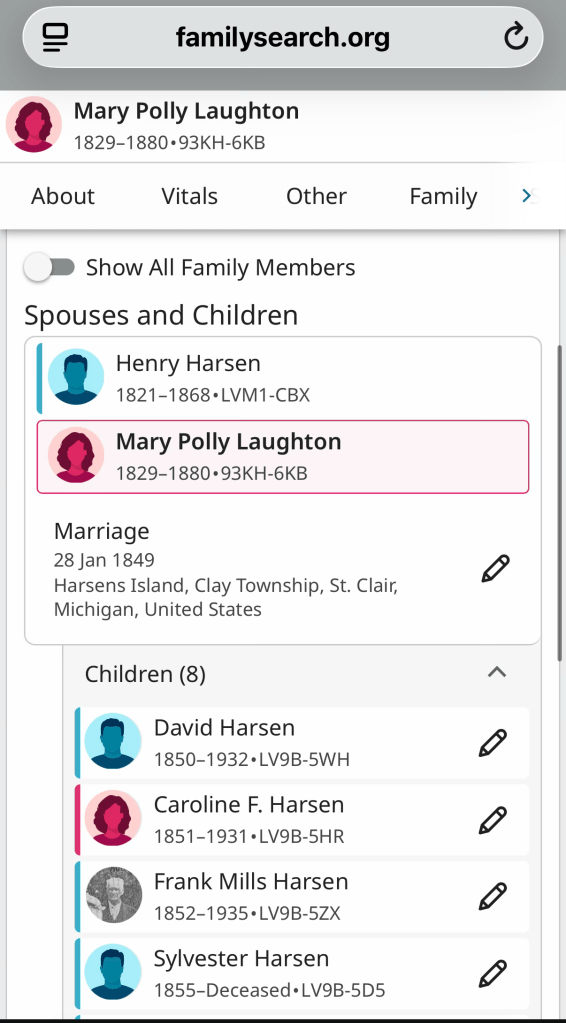
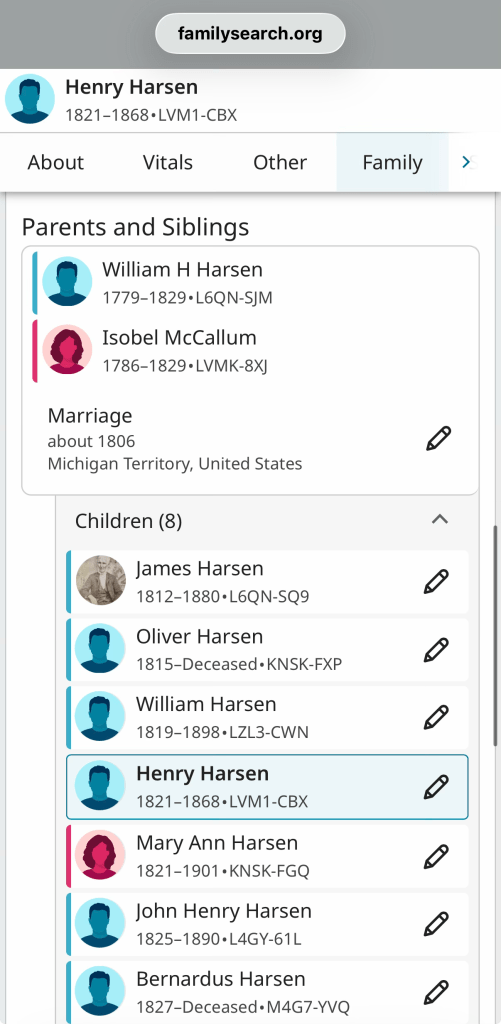
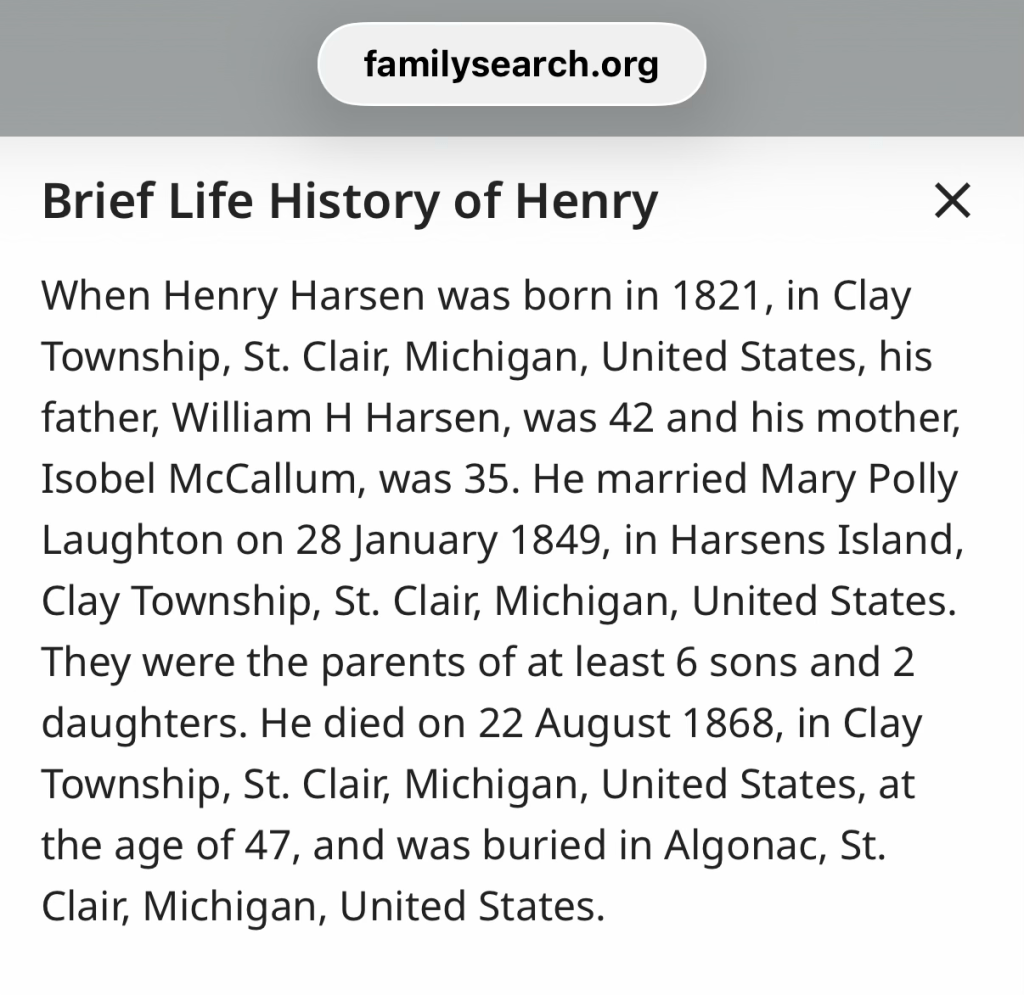
As a direct descendant, something that always piqued my interest was a longstanding claim that Mary Polly Laughton, who married Henry Harsen in St. Clair County, Michigan, in 1849, had Native American ancestry through her mother.
This article examines the surviving records connected to Mary Polly Laughton, evaluates the evidence for and against the tradition, and considers several possible explanations consistent with the historical record.
Rather than attempting to prove a predetermined conclusion, the purpose here is to examine what can—and cannot—be established from surviving documents

Who Was Mary Polly Laughton-Harsen?
Among the family stories that circulate in Harsen–Laughton genealogy, one of the most persistent is that Mary Polly Laughton — who married Henry Harsen on January 25, 1849, in Clay Township, St. Clair County, Michigan — was born of a mother who was “Indian or part Indian.” That claim has never been fully documented, and the available primary records raise significant questions about it. This post examines what the records show, where they are silent, and what explanations best fit the surviving evidence.

The 1849 marriage record, preserved in the Dibean Michigan Marriages Index (drawing on original St. Clair County registers), states:
25 January 1849, Clay — Henry Harson, 27, Clay Twp.; Parents: William Harsen & Isabelle McCollum. Mary Laughton, 20, St. Clair.
Her age of 20 at the time of the marriage places her birth around 1828–1829. She is identified as Mary Laughton, not by any other name or qualifier.
One year before the marriage, she appears in the St. Clair County Probate Court records as a ward of William Harsen Jr. — the same William who was Henry’s brother, and who had previously served as guardian for the children of Jacob Harsen II. The guardianship record from 1848 confirms her surname as Laughton and names her father as David Laughton. The document uploaded here — pages 506–507 of the St. Clair County probate register — shows her identified as “Polly Laughton, Daughter and Heir of David Laughton,” in a property transaction dated September 19, 1848, recorded April 19, 1858. This is the clearest primary identification of her parentage available in the surviving record.
The Historical Setting
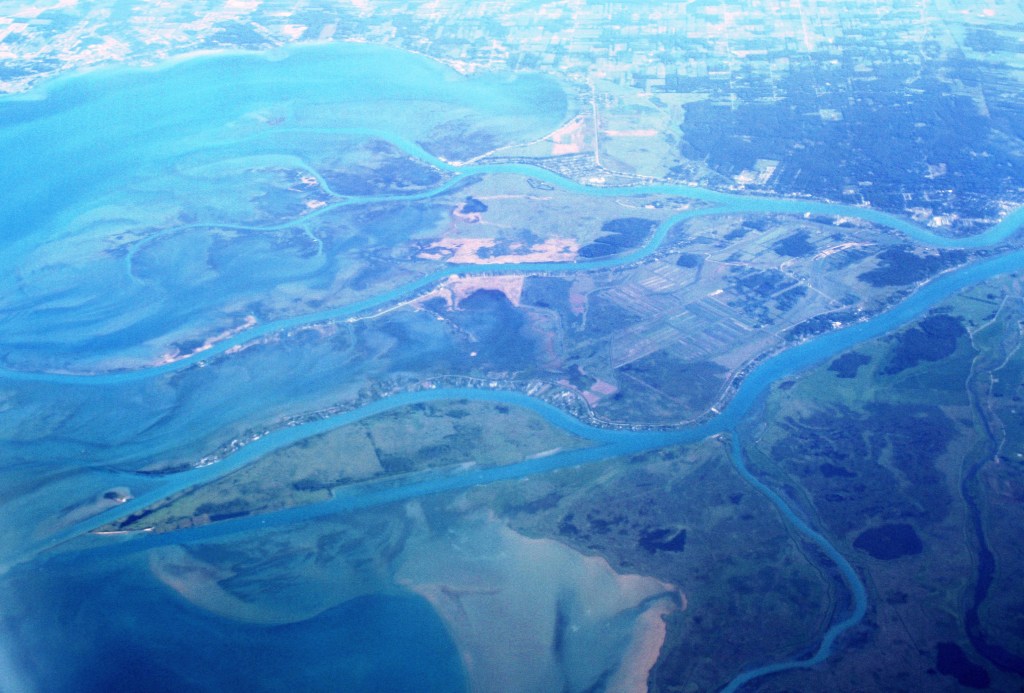
The St. Clair River region in the early nineteenth century was a fluid borderland connecting modern Michigan and Ontario. The area included:
- French-Canadian trading families
- British military and Loyalist settlers
- Dutch-descended New York families such as the Harsens
- Métis communities
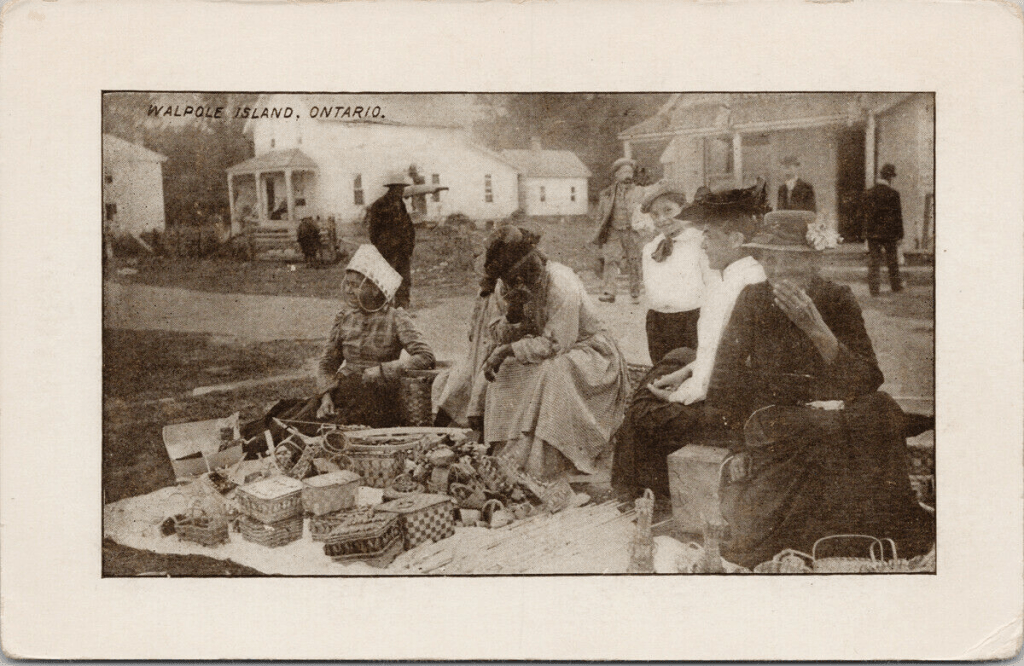
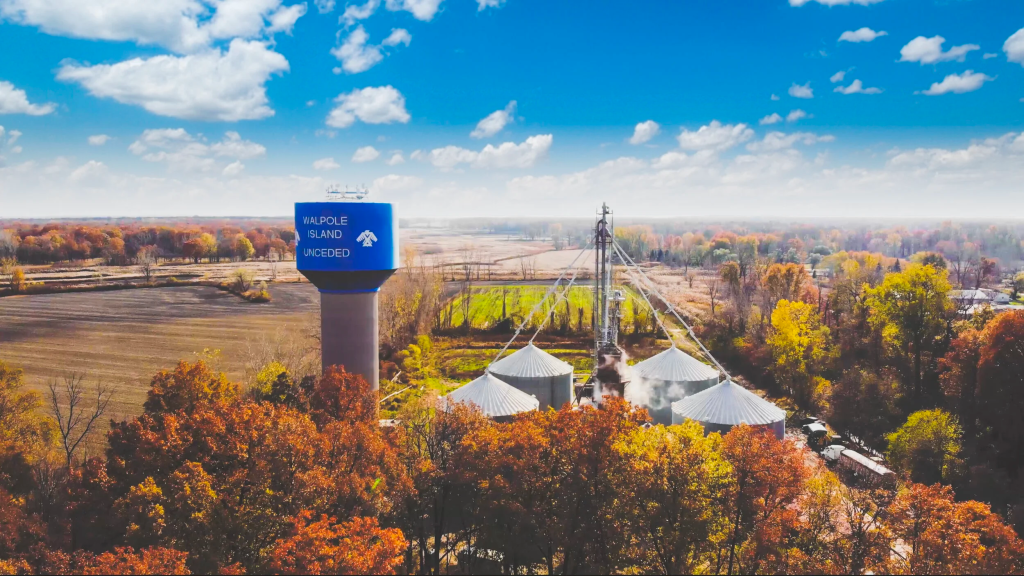
- Potawatomi and Anishinaabe populations associated with Walpole Island and the western Great Lakes
This environment produced overlapping kinship networks that do not always fit neatly into later racial or national categories.
What the Records Show — and Do not Show
The Probate Court’s Language
The same St. Clair County Probate Book A that records Mary’s guardianship also contains a striking piece of context: the estate of Jacob Harsen II (d. 1843) explicitly identifies his widow Frances (“Fanny”) Harsen as “an Indian woman.” The probate clerks of this court, in this period, did apply ethnic and racial descriptors when they considered them relevant. Frances Harsen’s Native identity was recorded directly in the official file.
Mary Polly Laughton’s guardianship file, by contrast, contains no such designation. She is identified by name and parentage, not by ethnic category. That absence is not conclusive — guardianship files did not always record race — but it is worth noting that the same court, in the same period, did record the distinction when it applied to another woman in the same extended family network.
The Census Record
Federal census enumerations from 1850 onward list each household member individually, with a color column. The Harsen household — Henry and Mary, and later Mary as a widow — appears in these enumerations in Clay Township, St. Clair County, and later in Lapeer County after the family moved north. The question of what those specific color columns record for Mary and her household is an empirical one best verified against the original images at Ancestry or FamilySearch, which hold the Michigan population schedules for 1850, 1860, 1870, and 1880.
The 1830 and 1840 censuses used a different format: tick marks by age and sex within column groupings for “Free White Persons,” “Slaves,” and “Free Colored Persons.” Mary would have appeared as a child in her father’s Laughton household in those years.
The Marriage Record
The 1849 St. Clair County marriage record is the foundational document for this family. The record itself — the original register — is held by the St. Clair County Clerk and available through FamilySearch (Michigan, County Marriages, 1820–1940). Whether the original register includes a dedicated race or color column for bride and groom is a question best resolved by examining the original image. Some Michigan county marriage registers of this period did include such columns; others did not. What the record unambiguously does show is her name, her age, her county, and her parents’ absence from the listed entries — consistent with her being an orphan or half-orphan at the time of the marriage, which the 1848 guardianship record supports.
The “Indian Mother” Claim: Three Possible Explanations
The claim that Mary’s mother was “Indian or part Indian” most likely derives from one of three sources:
1. A genuine but undocumented family tradition
It is possible that an oral tradition existed within the Laughton or Harsen families reflecting a real aspect of Mary’s ancestry that simply was not captured in the surviving written record. Unrecorded marriages, informal kinship ties, and ethnic identities that families chose not to register were all common in the Great Lakes frontier in the early nineteenth century. The absence of documentary evidence is not the same as documentary disproof.
2. Confusion with Frances (“Fanny”) Harsen
The most likely source of error is a conflation between Mary Polly Laughton and Frances Harsen — two women in the same extended family network, both connected to the Harsen probate proceedings of the 1840s. Frances is the woman explicitly identified as “an Indian woman” in the official St. Clair County record. Mary is a ward in a related proceeding from 1848. Over generations of family oral tradition, two women connected to the same probate court and the same family could easily be merged into one, with Frances’s explicitly recorded Native identity transferred to Mary.
3. The Illinois Laughton connection
The 1829 Treaty with the Potawatomi (29 July 1829) names “Waish-kee-Shaw, a Potawatamie woman, wife of David Laughton,” who received a land reservation in Illinois. The same treaty names Bernardus Laughton as a trader owed a debt of $1,016. The 1832 Treaty names “Joseph Laughton, son of Wais-ke-shaw” and lists B.H. Laughton as an interpreter. David and Bernardus Laughton operated the Buckhorn Tavern in Lyons, Illinois.
This is a documented Laughton family — in the same generation, in the same Great Lakes fur-trade world — where a David Laughton did have a Potawatomi wife and children of mixed Native descent. The Mary Polly Laughton records identify her father as David Laughton, the same name. Whether these are the same man, related men, or coincidentally named men in the same region at the same time is an open genealogical question. The House Document on Potawatomi land grants does not name Mary specifically, and no surviving record directly connects the St. Clair County Laughton household to the Illinois Potawatomi treaty family.
That said, the parallel is close enough to warrant further research. If Mary’s father David Laughton was related to or identical with the David Laughton of the 1829 treaty, the “Indian mother” story may reflect an accurate family memory of Waish-kee-Shaw — transmitted imprecisely across generations, with the identity of the Native woman garbled in the retelling.
Mary Polly in the Broader Harsen–Laughton Network
Mary Polly’s guardianship by William Harsen Jr. in 1848 — the same man who had administered the estate of Jacob Harsen II and served as guardian for his children — places her within what your broader family research describes as the “Harsen–Jacobs kin group”: the extended community of mixed European and Native descent living along the St. Clair River corridor in the 1840s. Her marriage to Henry the following year reinforces that placement.
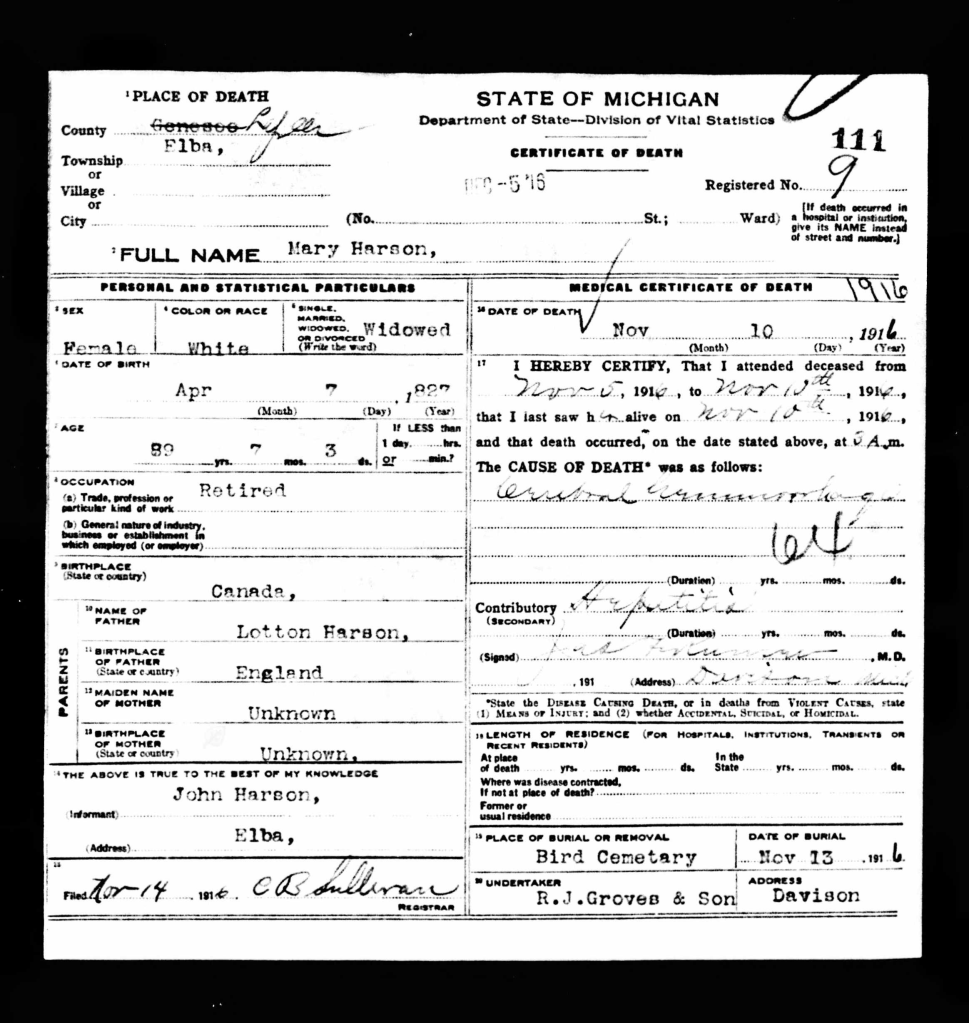
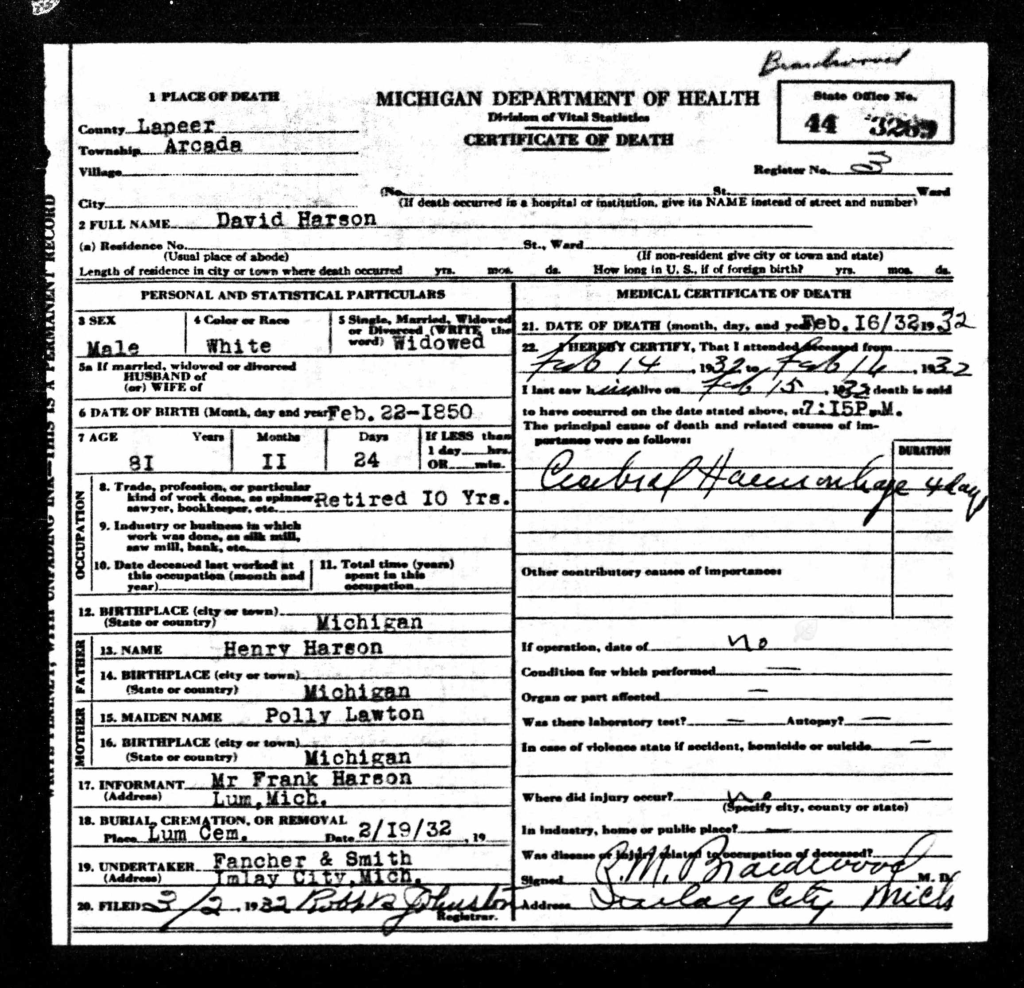
After the marriage, Henry and Mary moved north from Harsens Island to Lapeer County, settling in the Attica Township area. Henry died in 1868. His brother William Harsen Jr. — Mary’s former guardian — also moved to Lapeer County and is buried at Attica Township Cemetery (Find a Grave #70852091). Mary’s son David R. Harsen (Find a Grave #210404878) continued the family in Lapeer County.
David R. Harsen’s birth year of 1850 — just one year after the January 1849 marriage — confirms without much ambiguity that he is Henry and Mary Polly’s son.
This places the author five generations from Mary Polly Laughton, and six generations from any putative Native ancestor on her mother’s side.
DNA Evidence
This author has tested through both AncestryDNA and GenomeLink, with 0% Indigenous American ancestry on both platforms. These two results carry different weight and warrant separate consideration.
AncestryDNA works from reference panels of living populations, estimating recent admixture percentages. At five generations of distance from Mary Polly, a single Native ancestor on her mother’s side would represent approximately 1.5% of the author’s genome — a percentage that can fall below reliable detection thresholds in standard ethnicity estimates. On its own, a 0% result from AncestryDNA at this generational distance is suggestive but not conclusive.
GenomeLink’s ancient DNA analysis is a different matter. Rather than comparing against modern reference populations, it tests raw DNA against ancient genome datasets derived from archaeological remains — population signatures that go back thousands of years. Indigenous American ancient DNA signatures are genetically highly distinct from European ones, and those deep population signals persist across more generations than recent admixture percentages do. A 0% result on ancient DNA analysis at five or six generations of distance is meaningfully more informative than a standard ethnicity estimate, and represents a stronger — though still not absolute — genetic argument against a Native American ancestor in this line.
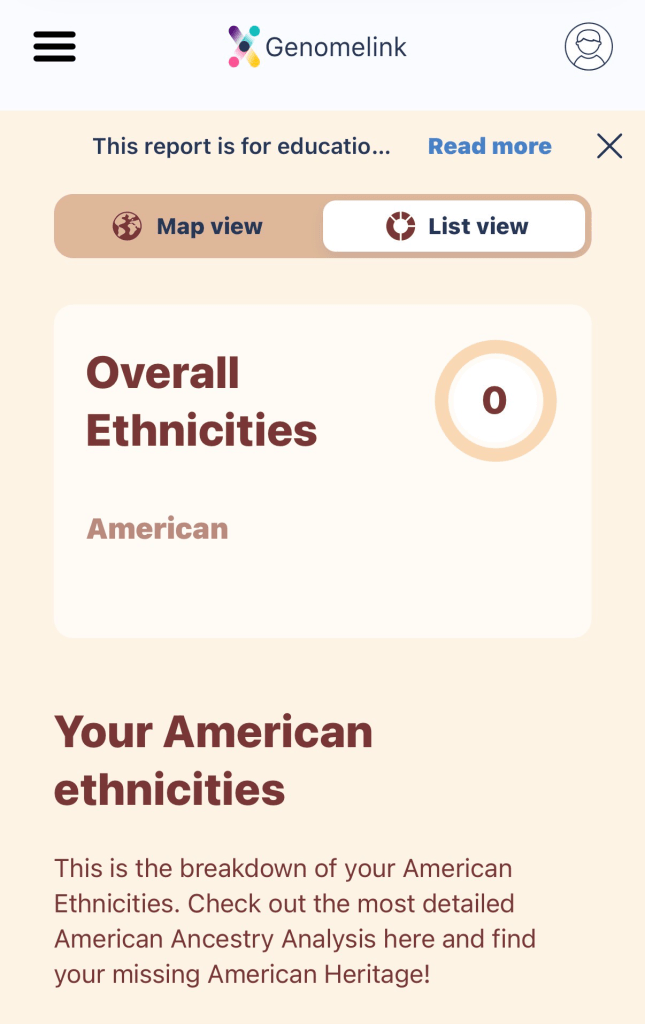
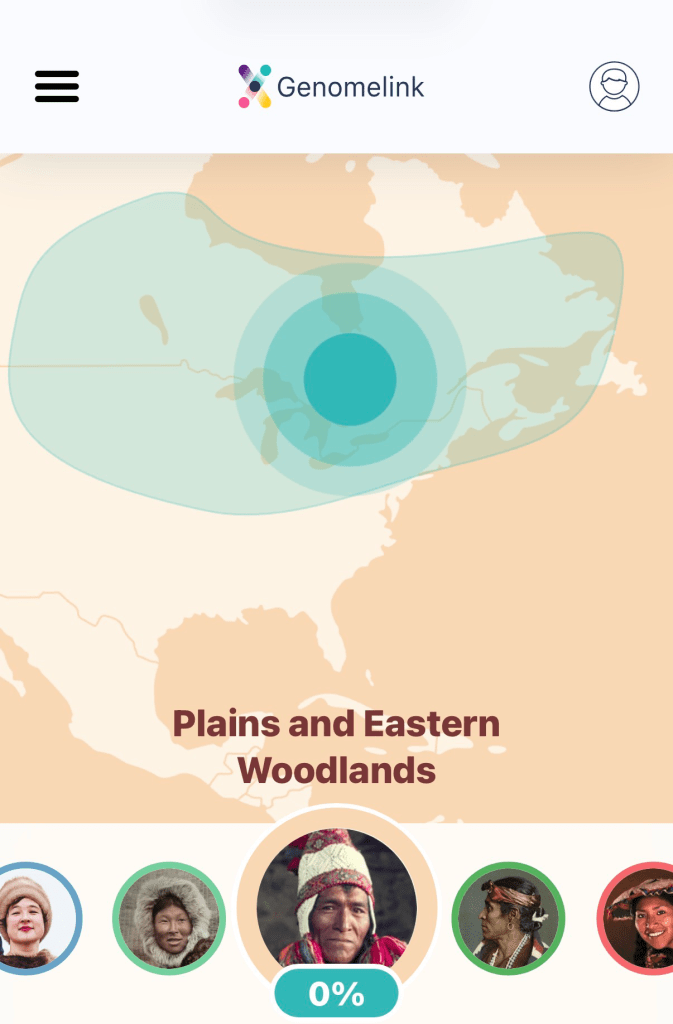
Taken together, the two 0% results are consistent with the documentary record but cannot be treated as definitive disproof. They raise the evidentiary bar for the “Indian mother” tradition without closing the question entirely.
What the Evidence Supports
A responsible reading of the available record supports the following:
- Mary Polly Laughton was the daughter of David Laughton, as confirmed in the 1848 St. Clair County probate document.
- She was guardianship ward of William Harsen Jr. in 1848, suggesting her father had died or was incapacitated.
- She married Henry Harsen in Clay Township on January 25, 1849.
- The same probate court that handled her case explicitly recorded Frances Harsen as “an Indian woman” — demonstrating that the court did apply such designations when it considered them relevant.
- A documented Illinois Laughton family includes a David Laughton with a Potawatomi wife and children of mixed descent, in the same generation and the same regional fur-trade world.
- No surviving primary record directly identifies Mary, her mother, or her immediate household as Native or mixed-ancestry.
- DNA testing of a direct descendant (5 generations removed) shows 0% Indigenous American ancestry on both AncestryDNA (standard ethnicity estimate) and GenomeLink (ancient DNA analysis). The ancient DNA result is particularly relevant given the generational distance involved.
What the evidence does not support is a definitive conclusion either way. The “Indian mother” tradition may reflect Frances Harsen’s documented Native identity misattributed to Mary through oral transmission; it may preserve a genuine memory of a connection to the Illinois Laughton–Potawatomi line; or it may be entirely without documentary foundation. Until further primary records emerge — particularly any record connecting Mary’s father David to the 1829 treaty Laughton family — the question remains open.
Conclusion
The genealogical record for Mary Polly Laughton is, in several important respects, incomplete. Her father is named; her mother is not recorded in any surviving document currently identified. The claim that her mother was Native American rests on oral tradition, not on a primary source. The most likely explanations for that tradition — confusion with Frances Harsen, or imprecise memory of the Illinois Laughton–Potawatomi connection — do not require that Mary herself had Native ancestry.
At the same time, absence of documentary evidence is not documentary disproof. The frontier record-keeping of the 1820s and 1830s in the St. Clair delta was incomplete, and many mixed-heritage families of that generation left no trace in the official record of the ancestry they carried. Mary Polly Laughton lived within a community where such connections existed; whether they were her connections remains, for now, an open question.
Sources
Primary records
- St. Clair County, Michigan, Probate Register, pp. 506–507 (September 19, 1848, recorded April 19, 1858): Mary Polly Laughton identified as “Daughter and Heir of David Laughton.”
- St. Clair County Probate Court, Book A (1843–1848): Estate of Jacob Harsen II; guardianship of Frances Harsen (“an Indian woman”); guardianship of Mary Laughton (1848).
- St. Clair County, Michigan, Marriage Records, 25 January 1849 (Henry Harson & Mary Laughton). Dibean Michigan Marriages Index (Jack & Marianne Dibean), rootsweb.com/~mistcla2/.
- U.S. Federal Census Population Schedules, 1830–1880, Clay Township (St. Clair Co.) and Attica Township (Lapeer Co.), Michigan — Laughton and Harsen households.
- Treaty with the Potawatomi, 29 July 1829, Article 4 (reservation to Waish-kee-Shaw, wife of David Laughton, and her child; debt payment to Bernardus Laughton).
- Treaty with the Potawatomi, 20 October 1832 (Joseph Laughton, son of Wais-ke-shaw; B.H. Laughton, interpreter).
- Revised Statutes of Michigan (1846), “Of Marriage and Divorce.”
- Find a Grave: William Harsen (1819–1898), Attica Township Cemetery, Lapeer Co., memorial #70852091; Henry Harsen (1821–1868), memorial #170355261; David R. Harsen, son of Henry and Mary Polly Laughton Harsen, memorial #210404878.
- Regional and secondary sources
- Jenks, William Lee. *St. Clair County, Michigan: Its History and Its People*. Chicago: Lewis Publishing, 1912.
- Algonac-Clay Historical Society, *Chronicle* (various issues).
- Demeter, Richard. “Jacob Harsen and the Early Settlement of Harsen’s Island.” *Delta News*, 1993.
- Digital Research Library of Illinois History Journal (Buckhorn Tavern / Lyons, Illinois references).
Context and background
- Harsen Family Blog (harsenfamily.org): “Reassessing ‘Lost in Translation’: Frances Harsen, Native Continuity, and the Unceded Story of Harsen’s Island” (October 12, 2025); “What’s In A Name” (October 12, 2025).
- Chiefs of Ontario, *Historical Report Assessing Métis and Indigenous Claims to Rights in S.O.N. Territory*, April 2025.
- AncestryDNA ethnicity estimate and GenomeLink ancient DNA analysis, direct descendant
*This post is based on public and archival records, verified secondary sources, and independent analysis. Every effort has been made to represent the documentary record accurately. Where the record is incomplete or ambiguous, that ambiguity is noted. Readers are encouraged to consult the cited primary materials and form their own conclusions.*
 Harsen Family Blog
Leave a comment